SDE++: Renewable electricity
The content of this page has been checked on 21 August 2026
Do you want to apply SDE++ subsidy for a wind turbine or solar panels? On this page you will find the general conditions for electricity production and the technology-specific application conditions.
 Stay informed via email
Wind
You can apply for a subsidy for wind turbines in these 3 categories:
Onshore wind
Onshore wind
You can apply for a subsidy for wind turbines on land.
Onshore wind with a height restriction
Onshore wind with a height restriction
Do you plan to build a wind turbine near an airport? Under national laws and regulations, the maximum tip height is 150 metres. The tip height is the distance from the ground to the tip of the highest blade.
This rule applies to wind turbines near the following airports:
- Schiphol
- De Kooy
- Deelen
- Eindhoven
- Gilze-Rijen
- Leeuwarden
- De Peel
- Volkel
- Woensdrecht
The rule also applies to wind turbines near the part of Kleine-Brogel Air Base that is located above Dutch territory.
More information about height restrictions
You can find more information about height restrictions in section 2.5.4 'Burgerluchthavens en militaire luchthavens (CNS en vliegveiligheid)' (Civilian airports and military airfields (CNS and aviation safety) of PBL’s memorandum 'Hoogtebeperkte categorie wind op land' (Height-restricted Onshore Wind') (in Dutch).
The ‘Viewer Hoogtebeperkingen Luchtvaart' (Viewer Aviation Height Restrictions) viewer is available on the page 'Hoogtebeperkingen luchtvaart' (Aviation height restrictions) of RVO’s website. This map shows the height limits near airports. The information comes from the Ministry of Defence and the Human Environment and Transport Inspectorate (ILT).
You can also apply for a subsidy for wind turbines in areas where height restrictions apply because they may interfere with military radar systems.
Wind on flood defences
Wind on flood defences
You can apply for a subsidy for wind turbines on a flood defence managed by Rijkswaterstaat. The turbines may also be located in nearby areas where building restrictions apply, such as on or near a dike.
These rules apply to primary flood defences. These protect the Netherlands from flooding in areas where water levels rise during storms or high water in major rivers, the IJsselmeer, or the Markermeer. They also include:
- the Volkerak-Zoommeer
- the Grevelingenmeer
- the tidal part of the Hollandsche IJssel
- the Veluwerandmeren
You can also apply for a subsidy for wind turbines near coastal flood defences. These are flood defences along:
- the North Sea
- the Westerschelde
- the Oosterschelde
- the Wadden Sea
- the Dollard
- the Eems
The hard and soft coastal defences of Maasvlakte 2 are also included. Examples are dunes and sea dikes on land.
You can also apply for a subsidy for wind turbines near front-line flood defences. These are flood defences with water on both sides, such as the Afsluitdijk and the Delta Works in Zeeland.
Wind turbines on inland dikes are not included. These dikes have much lower safety requirements. The costs are similar to those of regular onshore wind turbines. You can therefore apply for a subsidy for wind turbines on inland dikes under the Onshore Wind category.
Check all water defences on a map
You can find all water defences and sea water defences on the map ‘Wind op waterkering SDE++’.
Wind speeds
All municipalities in the Netherlands are divided into 5 wind speed categories. For each wind speed category, we calculate a different base amount.
The wind speed categories are:
- ≥ 8
- ≥ 7.5 en < 8.0 m/s
- ≥ 7.0 en < 7.5 m/s
- ≥ 6.75 en < 7.0 m/s
- < 6.75 m/s
Wind map
For all wind categories, we use the Windviewer. This map shows the average wind speed for each municipality in the Netherlands and is based on a wind map from KNMI. The SDE++ 2026 uses the municipal boundaries as of 1 January 2026. You can find a list of the municipalities in Annex 2 of the ‘Aanwijzingsregeling SDE-categorieën’. Each wind category has its own base amount.
The wind map shows which wind speed category applies to your project location. When submitting your subsidy application, you must select the municipality where you will carry out the project. Note: the name of the municipality may be different from the name of the town or city of your project.
Because wind speeds in the municipality of Rotterdam vary a lot, this city has been divided into districts and neighbourhoods. Please take this into account when selecting the correct municipality.
Combined applications
You can combine applications in the wind categories. This can be useful if you want to take on the project together with other applicants, but only if all applications in the bundle get a subsidy.
If more subsidy is requested on one day than the available budget, we rank the applications based on subsidy intensity, in euros per ton of CO₂ reduction. For a combined application, the highest amount of the applications in the bundle is used.
If it becomes necessary to draw lots, the whole bundle is treated as one application.
Replacement of wind turbines
You can also apply for a subsidy if you are going to replace wind turbines. This is only allowed if:
- the nominal capacity of each new wind turbine is at least 1 MW higher than the old one; or
- the wind turbine has been in use at the same location for 15 years at the time of replacement, and it was taken into use at least 13 years before the subsidy application.
Solar PV
You can apply for a subsidy for solar panels (solar PV). These must have a peak output of 15 kWp or more and be connected to the grid with a total maximum capacity of more than 3 x 80 A (a large-scale grid connection).
You can apply for a subsidy for photovoltaic solar panels in these categories:
Solar PV building-mounted
Solar PV building-mounted
You can apply for a subsidy for solar panels that are installed on a roof or mounted on a building façade. A permanent canopy that protects vehicles from the weather is also considered a building. This does not apply to canopies with another purpose, such as structures that cannot be used to shelter vehicles.
Please note: if your building façade faces east or west, separate categories apply.
Solar PV building-mounted with minor roof alterations or lightweight panels
Solar PV building-mounted with minor roof alterations or lightweight panels
This category is for:
- Installations that require minor changes to an existing roof. These may include changes to the roof or building structure, or the installation of a support structure for the solar panels. You must include a statement from a structural engineer with your application. The statement must explain what changes are needed to make the structure suitable for the installation.
- Installations with lightweight solar panels. These panels must weigh no more than 10 kilograms per square metre of roof area covered by the panels.
Solar PV on east- and west-facing building walls
Solar PV on east- and west-facing building walls
Solar panels on east- and west-facing building walls help spread the load on the electricity grid more evenly throughout the day. An east-facing wall produces electricity in the morning, while a west-facing wall produces electricity in the afternoon and evening.
This setup matches your energy needs in the morning, afternoon, and evening. However, the total yearly electricity production is lower than for a south-facing wall (approximately 15% to 20% less).
Solar PV floating on water
Solar PV floating on water
You can apply for a subsidy for solar panels that are installed on floating structures on water. This also applies to solar panels placed at sea.
On land
On land
You can apply for a subsidy for solar panels that are installed on land. If you install the panels on the ground, you must do this in a nature-inclusive way. This means that you take into account the welfare of flora and fauna.
Please note: there is a separate category for vertically installed solar panels.
Solar tracking system on land
Solar tracking system on land
With solar tracking systems on land, the panels automatically follow the position of the sun. This allows you to produce more energy. Solar tracking systems have higher investment costs than standard systems. However, they also have a higher number of full-load hours for which you can receive a subsidy. Therefore, the base amounts and correction amounts are the same as for standard systems.
A feasibility study is required for solar tracking systems. You must also include an energy yield calculation with your application. This calculation is used to determine the maximum number of full-load hours.
Solar park with tracking and non-tracking solar panels
Are you applying for a subsidy for a solar park where not all solar panels follow the sun? Then you must submit 2 separate applications: one for the portion of the subsidy with solar tracking panels and one for the part without solar tracking panels.
You only need to include an energy yield calculation with the application for the solar tracking portion. It is not possible to change the category after submitting your application.
If panels are installed on the ground, this must be done in a nature-inclusive way. This takes into account the welfare of flora and fauna.
Solar PV vertical on land
Solar PV vertical on land
You can apply for a subsidy for two-sided solar panels that are installed vertically on land. This allows the land to be used for 2 purposes, e.g. agriculture or livestock farming. This type of installation also helps spread the load on the electricity grid more evenly throughout the day.
If you install the panels on the ground, you must do this in a nature-inclusive way. This takes into account the welfare of flora and fauna.
Solar PV along roads and railways
Solar PV along roads and railways
The category for solar panels along roads and railways is new.
This category is for projects located directly along roads and railway lines. These projects are often more difficult to carry out, which means that the costs are higher.
Only projects built on land with the designation “traffic” in the zoning plan or environmental plan are eligible for a subsidy in this category.
If you install the panels on the ground, you must do this in a nature-inclusive way. This takes into account he welfare of flora and fauna.
Conditions for Solar PV
The following conditions apply to Solar PV:
You only receive a subsidy for electricity supplied to the grid
You only receive a subsidy for electricity supplied to the grid
From the 2024 application round onwards, you will only receive a subsidy for generated electricity that you supply to the electricity grid.
Solar-PV on land must be nature-inclusive
Solar-PV on land must be nature-inclusive
From 2026, there are 2 ways to meet the requirements for a nature-inclusive solar park:
- You include the conditions in the permit.
- Seen from above, there must be at least 25% open space between the rows of solar panels. See drawings below.
- You must provide a layout plan and a management plan to prevent a decline in soil quality, water quality, and ecological quality during the subsidy period.
- You must monitor the effects of the solar installation on soil quality, water quality, and biodiversity. If needed, you must take extra measures to prevent damage to nature during the subsidy period.
- You must carry out a baseline measurement to find out the current quality of the soil, water, and ecology.
To assess your application, it is important that the local authority includes these conditions in the environmental permit.
- You have a certification mark.
You can also apply for a subsidy for a nature-inclusive solar park if you have a certification mark.
This certification mark shows that the installation:
- does not have negative effects on plants, animals, and biodiversity;
- has enough space between the solar panels for light to reach the ground and to maintain soil and water quality;
- fits well into the landscape.
An example of such a certification mark is EcoCertified.
25% open space between row of solar panels
Seen from above, there must be at least 25% open space between the rows of solar panels.
In the 4 pictures below, you can see different situations.
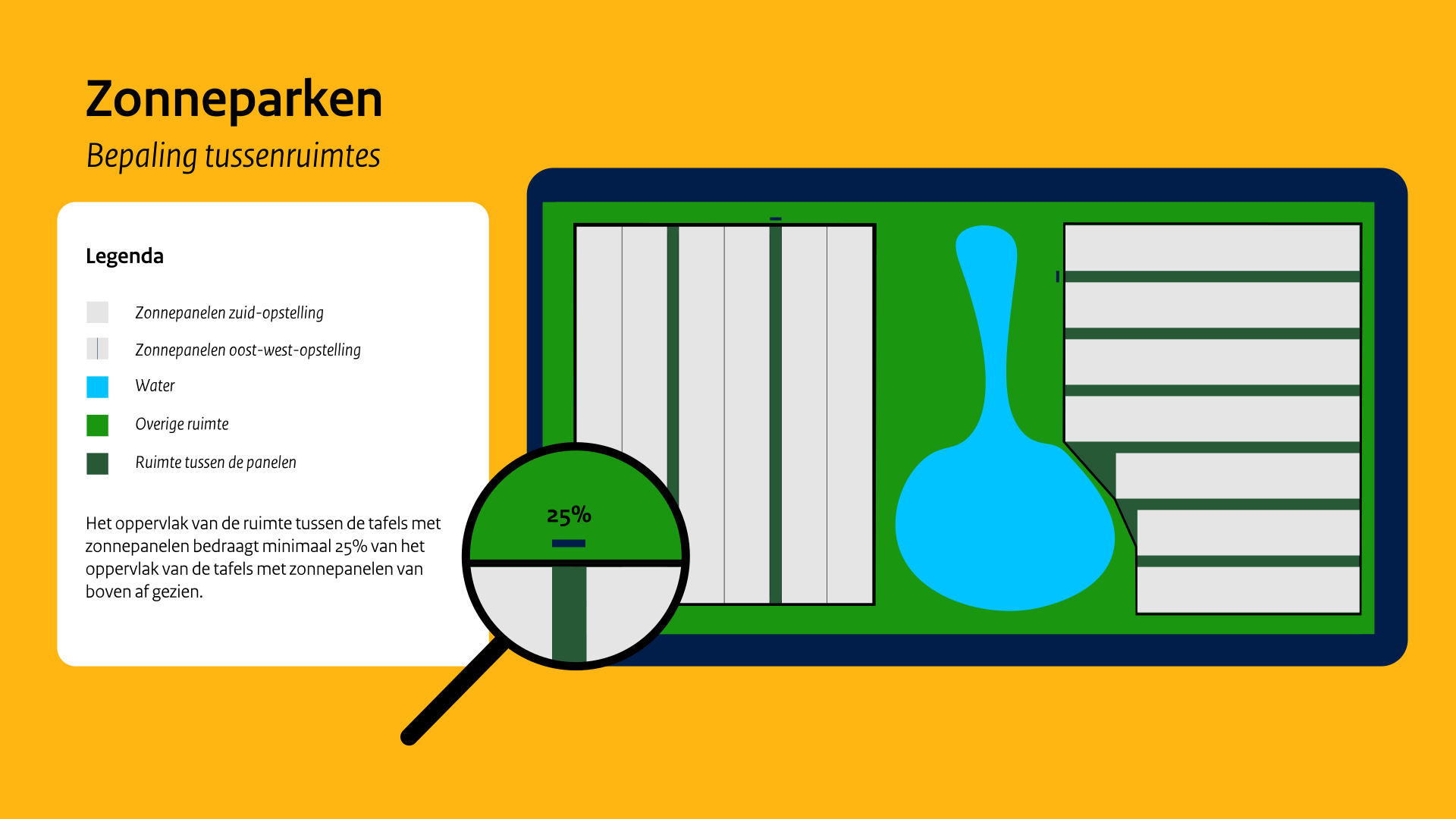
Only the space between the tables with solar panels counts. The space around the outer tables does not.
Is there a pond, ditch, or something else between the tables with solar panels that creates extra space? Then you cannot use that extra space to compensate less space between other tables.
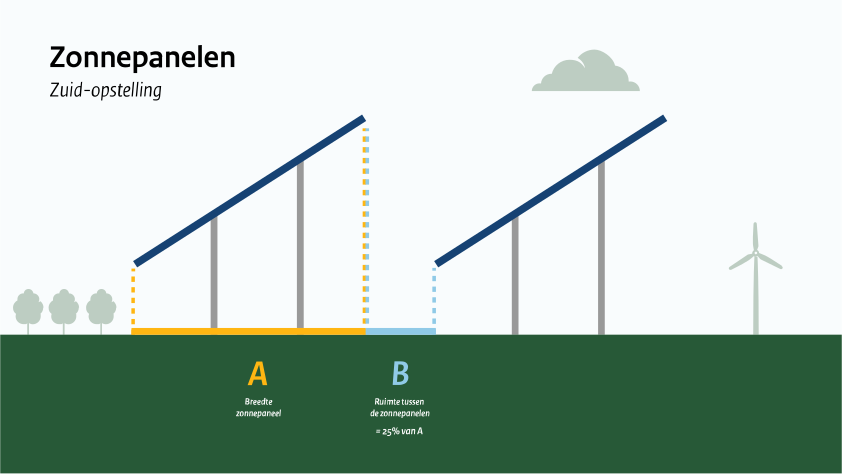
In a south-facing setup, the space between the tables is at least 25% of the width of the table.
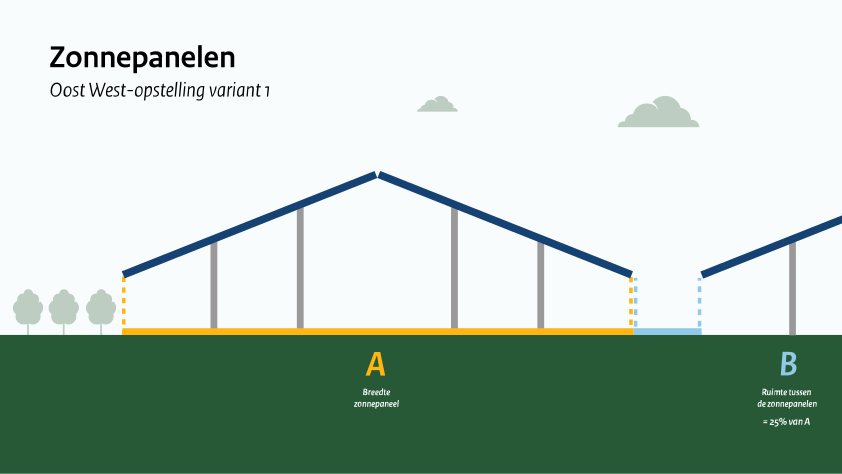
In an east-west setup, the east and west sides are seen as one table. The space between the tables must be at least 25% of the width of the table on the east side plus the length of the table on the west side. It does not matter if the tables touch at the top (the highest point) or if there is space at the top.
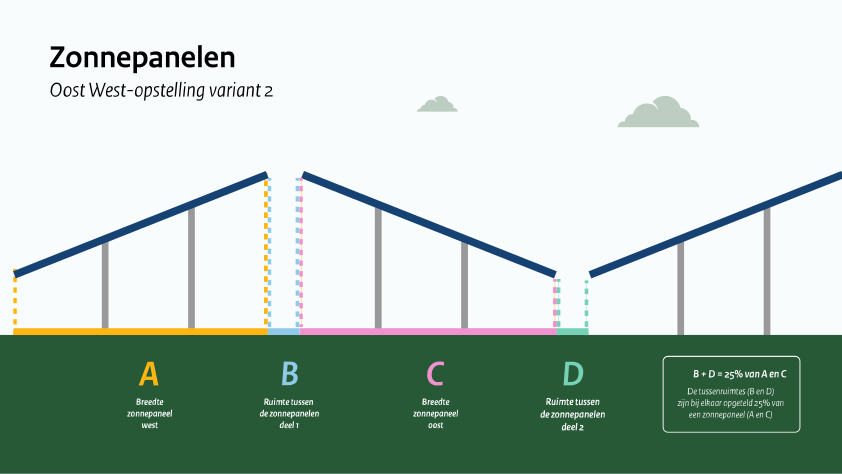
In an east-west setup, is there space at the top (the highest point)? Then you may use this space to make up for having less space at the bottom (the lowest point). This space can count towards the 25% open space requirement.
Used materials
Used materials
You can apply for a subsidy for a production system that is partly made with used materials. However, the solar panels and the inverter must be new.
Large-scale grid connection
Large-scale grid connection
The Solar PV category is only for installations that are connected to the electricity grid through a large-scale consumer connection. This is a grid connection with a total maximum capacity of more than 3 x 80 amperes (A).
You may also connect your installation to the grid through multiple large-scale consumer connections. It is also possible to connect your installation through the large-scale consumer connection of an adjacent property.
However, the installation must always be located at the site for which we grant the subsidy.
You may connect your system to the electricity grid through the large-scale grid connection of a nearby site. Your system must be built at the location for which the subsidy is given.
Do you want to build your system on 2 nearby sites? Or does your location have more than one street adress? Then explain this clearly in your subsidy application.
Do you have a small consumer connection?
Are you a producer with a small consumer connection? Then you may be able to apply for the Subsidieregeling Coöperatieve Energieopwekking (SCE) (Subsidy Scheme for Cooperative Energy Generation).
Restriction of additionally contracted feed-in capacity
Restriction of additionally contracted feed-in capacity
The feed-in capacity for which you sign a contract may not be more than 50% of the peak capacity of your Solar PV installation. This requirement applies to many Solar PV projects, but not to solar tracking projects or vertical Solar PV systems on land.
This allows more renewable energy projects to use the available space on the electricity grid. We compensate your project for the small loss in energy yield caused by a lower number of full-load hours by providing a higher base amount. This measure ultimately leads to more renewable electricity from solar panels.
In the application form, we will ask you additional questions about your grid connection and your contracted feed-in capacity.
New contract or expansion of existing contract
There are different situations:
- You have a new contract. For new grid connections, there is no existing feed-in capacity. This means that the contracted feed-in capacity may not exceed 50% of the peak capacity of your solar panels.
- You are expanding an existing contract. For existing contracts, you do not need to include feed-in capacity that is used for other installations, such as a wind farm or an existing Solar PV installation.
Did you already have a contract with the grid operator before applying for a subsidy? And is this contract not yet used for a different installation? Then you must have the contract adjusted so that it meets the requirements of the scheme.
It is also possible that your current feed-in capacity is higher than the peak capacity of your existing installation. In this case, this capacity is deducted from the maximum 50% that you can contract for the peak capacity of your new installation.
CO2 footprint of solar panels
CO2 footprint of solar panels
In 2026, you may only use solar panels that have caused a maximum of 550 kg of CO2 emissions per kWp during production. To prove this, your panels must have an environmental product declaration according to the EPD-Norge method. Keep this requirement in mind when purchasing your panels.
You do not need to prove this at the time of your subsidy application. You only need to provide proof after you have actually purchased the solar panels. The decision letter will state when you must send us a copy of your purchase documents.
Bifacial solar panels
If you use bifacial solar panels, you can apply for a subsidy for a higher capacity (in kWp). The annual energy yield of these panels in the Netherlands is up to 5% higher than that of a system with single-sided panels. This only applies to systems that are south-facing and installed on land.
With your subsidy application, you must explain how you calculated the stated capacity. You can use data from the solar panel you plan to install for this calculation.
Profile and imbalance factor for Solar PV and Wind
The profile and imbalance factors are figures that the Planbureau voor de Leefomgeving (PBL, Netherlands Environmental Assessment Agency) sets every year. PBL uses these factors to calculate the market value of solar and wind energy within the SDE++ subsidy scheme.
These factors take into account the difference between the market value of the electricity produced and the average electricity price. They also take into account the costs and risks that arise when actual production differs from the expected production.
From the 2025 application round onwards, we calculate the subsidy for wind and solar energy categories in a slightly different way. The imbalance factor is now included in the base amount. The profile costs are included in the correction amount.
You will still receive compensation for these costs. However, the subsidy amount may be different from previous years.
Download a table with tariffs for your installation
Would you like to know the amounts that apply to the category you are interested in? Download the table Tariffs Renewable electricity SDE++.
Please note: the subsidy you ultimately receive is the difference between the amount you applied for (the application amount) and the average market price for electricity. This market price is not the price you receive for your electricity, but an average that applies to everyone.
Every year, we adjust your subsidy based on the value of the electricity you supply to the grid. We also include the value of your Guarantees of Origin (GOs) in this adjustment.

- Ministry of Economic Affairs and Climate Policy