New offshore wind farms
The content of this page has been checked on 19 August 2026
Offshore wind is important for the Netherlands. How much do we want to generate? And when would we like to realise new wind farms?
Why is wind energy important?
We would like to be energy independent. And as the Netherlands becomes more sustainable, our electricity consumption will increase. The intention is to use increasingly more and more electricity instead of fossil fuels.
Offshore wind energy provides 'clean’ electricity that reduces CO2 emissions. It is also a reliable source of energy because of strong and constant winds in the Dutch North Sea. That is why we will need a lot of it in the future, because we want to be climate neutral by 2050.
Goals
We have more than achieved our first goal of 4.5 GW in 2023. In total, we had 4.7 GW of offshore wind energy by the end of that year.
Under the current Offshore Wind Energy Roadmap, our goal is to reach 23 GW installed capacity. When we reach the 23 GW goal, Dutch offshore wind farms will supply 16% of the energy we need in the Netherlands. Permits for 5.5 GW of capacity have already been awarded to developers and new wind farms are under construction.
By 2040, we will need between 30-40 GW of offshore wind energy capacity. This will enable us to generate enough energy to meet the Netherlands’ energy consumption needs. This is stated in the North Sea Wind Energy Infrastructure Plan of July 2025.
That is less than the previously expected estimate of 50GW. This is because the transition from fossil fuels to electricity use by, amongst others, industry, is lagging behind. The costs of constructing offshore wind farms have also risen.
You can read more about the North Sea Wind Energy Infrastructure Plan on the page Offshore Energy Infrastructure.
Initiatives to facilitate the development of offshore wind farms
We are committed to making it quicker and easier to build offshore wind farms. Through financial support, new contracts and improved regulations, we are ensuring that the development of offshore wind energy can continue.
Offshore wind energy action plan
Offshore wind energy action plan
Due to rising costs and less demand for electricity than expected, development of offshore wind energy is stalling. We did not receive any applications for the permit for Nederwiek Site I-A.
The Ministry of Climate Policy and Green Growth had anticipated that there might not be any applications. That is why the Minister presented the Offshore Wind Energy Action Plan on 16 September. This contains measures to financially support the construction of new wind farms. The plan also provides solutions to further stimulate demand for offshore wind energy.
Read more about the action plan (in Dutch).
Two-way contracts for offshore wind energy
Two-way contracts for offshore wind energy
From 2027, the Netherlands will transition from subsidies to two-way contracts to support the construction of offshore wind farms. These contracts are also known as Contracts for Difference (CfDs). Under a CfD, developers enter into an agreement with the government, setting a fixed price for the energy generated. If the market price is lower than the agreed rate, developers receive financial support; if the price is higher, they pay the difference back to the government.
As more of these contracts are introduced, their influence on the electricity market will grow. To better understand their impact, we commissioned TNO to conduct a study on how CfDs will affect the future of the Dutch electricity market. The report is attached below, in Dutch. The findings include recommendations for CfD design, with preliminary choices outlined in the Letter to Parliament of 20 March for offshore wind, onshore wind, and solar energy (attached below). The first offshore wind CfDs are planned to launch towards the end of 2027.
For more information on why the Netherlands is switching to CfDs, visit the page on two-way contracts for solar and wind energy (in Dutch).

New rules for mining companies
New rules for mining companies
The North Sea is becoming increasingly busy. Wind farms, gas extraction, and CO2 storage must be able to work effectively alongside each other.
Currently, mining companies can sometimes start projects unexpectedly in areas designated as wind energy areas. This can delay the construction of wind farms. To reduce uncertainty, we are adjusting the rules. From 2028, mining companies will need to apply for a permit earlier if they want to operate in a wind energy area. This should improve cooperation between wind farm developers and mining companies.
Projects that have already started do not need to comply with these new rules.
Read more about the new rules in the Letter to Parliament below.
More room for wind energy thanks to new helicopter flight methods
More room for wind energy thanks to new helicopter flight methods
Helicopters flying to drilling platforms require a lot of space. To reduce the space needed, we are testing new flight procedures such as Point in Space (PinS). With this method, helicopters land and take off using satellite guidance. This technique allows helicopters to fly safely to platforms while using less space for their routes.
This saves 5 to 7 times more space, freeing up additional room for wind energy.
The first PinS procedure is likely to receive approval as early as 2026.
Offshore Wind Energy Roadmap
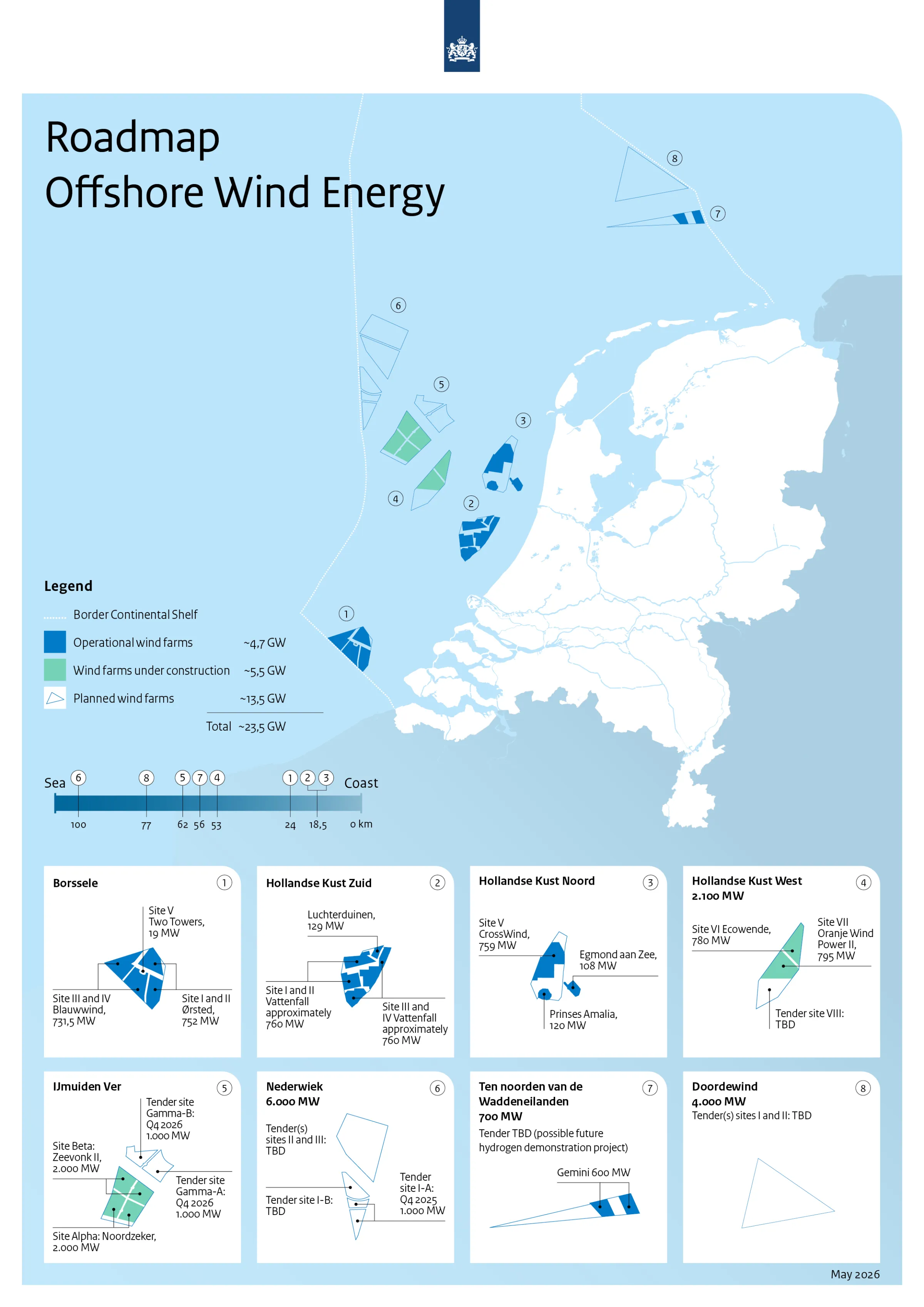
The Offshore Wind Energy Roadmap shows where wind farms are located or planned. The table below shows when we will issue a permit for these planned wind farms and when the future developer is likely to put the wind farm into use. Offshore wind farms already under construction are also in the table.
| Installed power | Wind Farm Site (WFS) | Permit procedure | (Expected) commissioning of wind farm |
| 0.76 GW | Hollandse Kust (west) WFS VI | 2022 | 2026-2027 |
| 0.76 GW | Hollandse Kust (west) WFS VII | 2022 | 2027 |
| About 2 GW | IJmuiden Ver WFS Alpha | Q1 2024 | Q3 2029 |
| About 2 GW | IJmuiden Ver WFS Beta | Q1 2024 | Q4 2029 |
| About 1 GW | IJmuiden Ver WFS Gamma-A | Q4 2026 | Q2 2032 |
| About 1 GW | IJmuiden Ver WFS Gamma-B | Q4 2026 | Q2 2032 |
| About 1 GW | Nederwiek WFS I-A | To be determined | To be determined |
| About 1 GW | Nederwiek WFS I-B | To be determined | To be determined |
| About 2 GW | Nederwiek WFS II | To be determined | To be determined |
| About 2 GW | Nederwiek WFS III | To be determined | To be determined |
| About 2 GW | Doordewind WFS I | To be determined | To be determined |
| About 2 GW | Doordewind WFS II | To be determined | To be determined |
| About 0.7 GW | Ten noorden van de Waddeneilanden WFS I | To be determined | To be determined |
| About 0.7 GW | Hollandse Kust (west) WFS VIII | To be determined | To be determined |
Caption
Caption
Logo of the Dutch government.
Map of the Netherlands and part of the North Sea. All operational wind farms, those under construction, and planned wind farms are indicated within the North Sea area.
Legend to the Roadmap. This shows the Continental Shelf Boundary, the operational wind farms that will generate approximately 4.7 gigawatts of electricity, the wind farms under construction that will generate approximately 5.5 gigawatts, and the planned wind farms that will generate approximately 11.5 gigawatts of electricity. This amounts to a total of approximately 21.5 gigawatts.
Part of the legend showing the distances of the wind farms from the coast:
Nederwiek from 100 kilometers, Doordewind from 77 kilometers, IJmuiden Ver from 62 kilometers, Ten Noord van de Waddeneilanden from 56 kilometers, Hollandse Kust West from 53 kilometers, Borssele from 24 kilometers, Hollandse Kust Zuid and Hollandse Kust Noord are both 18.5 kilometers from the coast.
Line drawing of the Borssele wind farm, seen from above. The wind farm is divided into the following sites: Site 5 developed by Two Towers, Sites 3 and 4 by Blauwwind, and Sites 1 and 2 by Ørsted.
Line drawing of the Hollandse Kust Zuid wind farm, seen from above. The wind farm is divided into the following sites: Luchterduinen, Sites 1 and 2 by Vattenfall, and Sites 3 and 4 by Vattenfall.
Line drawing of the Hollandse Kust Noord wind farm, seen from above. The wind farm is divided into the following sites: site 5 by CrossWind, Egmond aan Zee, and Prinses Amalia.
Line drawing of the Hollandse Kust West wind farm, seen from above. The wind farm is divided into the following sites: site 6 by Ecowende, site 7 by Oranje Wind Power 2, and site 8.
Line drawing of the IJmuiden Ver wind farm, seen from above. The wind farm is divided into the following sites: Gamma-B, Gamma-A, Beta, and Alpha.
Line drawing of the IJmuiden Ver wind farm, seen from above. The wind farm is divided into the following sites: 2 and 3, site 1-A, and 1-B.
Line drawing of the wind farm Ten Noorden van de Waddeneilanden, seen from above. The Gemini site is visible.
Line drawing of the Doordewind wind farm with site 1.
New wind farm zones
To support the growth of offshore wind energy after completion of the current Roadmap, the Government is already designating new wind farm zones. These zones are included in the Partial Revision of the North Sea Programme 2022-2027 (attached below). Within these zones, the Government can later designate new wind farm sites.
The revision carefully considers the impact on the environment, as well as the interests of offshore wind and other North Sea stakeholders. The Government aims to balance these priorities effectively.
Which areas are involved?
The following areas have been identified for potential future wind farms:
- Search area 6/7: this area is reserved for wind farms, ensuring space will remain available for other activities (such as fishing and shipping).
- Doordewind: this area will expand westward to accommodate an additional 2 GW of wind energy.
No offshore wind farms will be developed in the Lagelander area.
Research in new areas still ongoing
Ecological research is currently underway in Search area 6/7 and Doordewind. Therefore, it is not yet certain whether there will be enough space for 40 GW of offshore wind energy. By designating these new areas now, we avoid a delay of at least 2 years.
We are also exploring additional areas for offshore wind energy in preparation for the next North Sea Programme (2028–2033). More updates on this will be published later this year in the National Energy System Plan (NPE) and the Offshore Wind Energy Roadmap.
Research into the energy yield of offshore wind farms
An external study published at the end of 2025 suggested that the Dutch Government may have overestimated the expected energy yield of offshore wind farms. The researchers used different assumptions about the size and configuration of wind farms to those used by the Government. As a result, the energy yield in the study was lower.
In the Letter to Parliament of 20 January (attached below), you can read that the Government relies on independent and scientific research methods and their assumptions, to inform its offshore wind energy policy. Therefore, the expected energy yield of offshore wind energy will not be adjusted. The role of offshore wind energy in the future energy system remains unchanged.
The Government, together with organisations such as RVO, continues to conduct independent research to better estimate the energy yield of offshore wind farms. For example, the Wake Study, conducted by the Ministry of Climate and Green Growth together with RVO, analyses the energy yields of existing and planned offshore wind farms.
Currently, the BeNeWakes project is investigating how offshore wind farms and individual turbines interact and the impact of these interactions on energy yield. Read more about this research.
Read the letter to Parliament:
Plans for offshore energy infrastructure and landfall
There are also plans for offshore energy infrastructure and the landing of wind energy (from sea to land). More information about this can be found on the pages below.
Want to know more?
In the documents below you can read more about the Government's vision for offshore wind energy.
Questions about offshore wind energy?
Email to woz@rvo.nl
- Ministry of Economic Affairs and Climate Policy
Featured
View more
Read more
Learn more